
New Arran Blocs

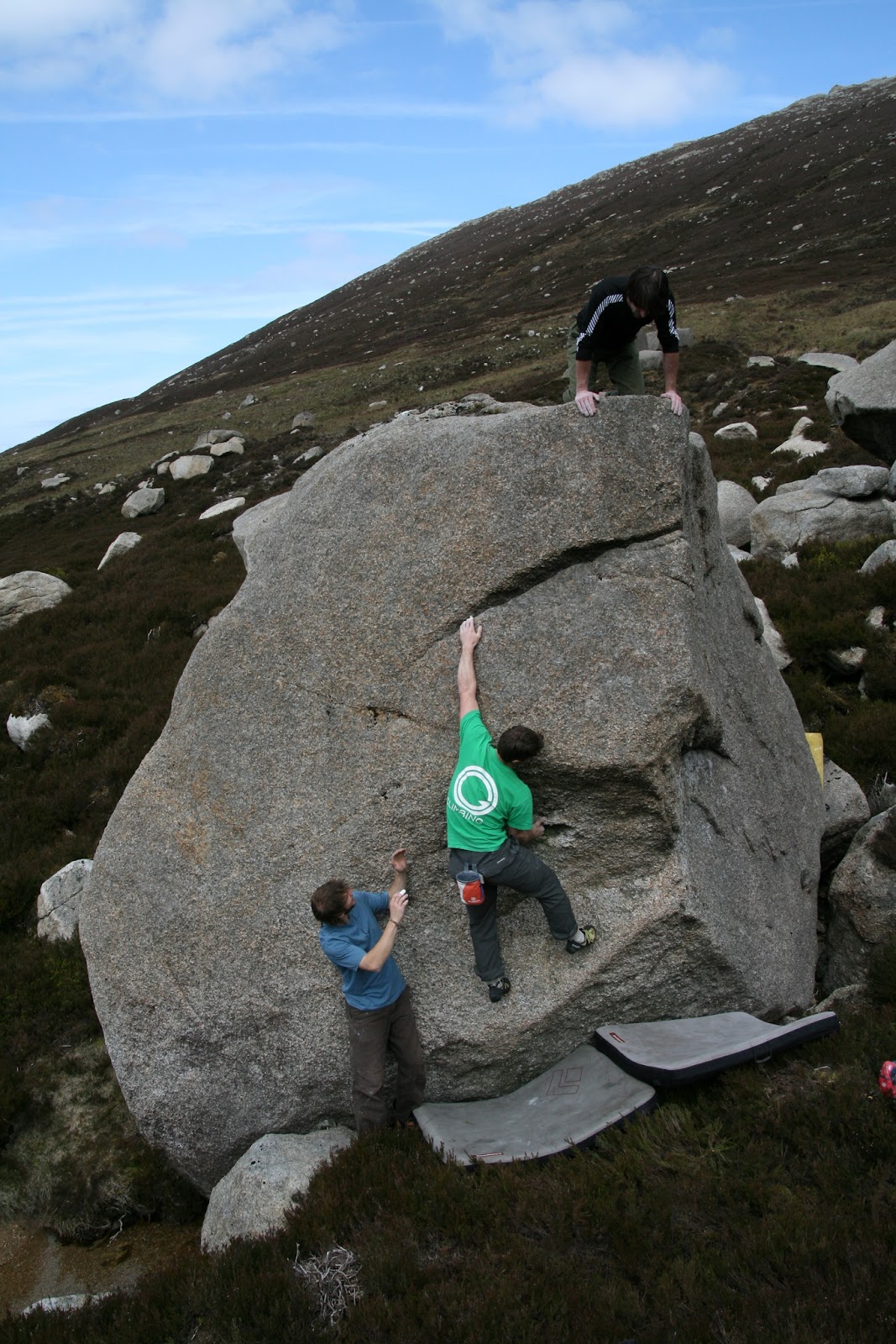
 Simon working the big roof...

Arran is a like a big granite lump of dough that someone has pushed an icy thumb into several times - the big corries pinch out the crusty ridges and the crumbs have all tumbled down into the bowls, trailed out in long deposits by the slabbery dribble of glaciers. The fringe of the island is dotted with big erratics that have tried to make it to the sea, such as the 'Corrie' boulders, but the densest collection of rocks lies in the higher corries such as Fionn corrie, Garbh corrie and Coire nan Ceum.


We took the opportunity of a good forecast to get the first sunburn of the year with a hike into Coire nan Ceum, via the bounciest bus on the island (the 324), then a pleasant stomp up the North Sannox burn to the boulderfield (45 min). Folk have mentioned this place to me over the years, Claire Youdale had said there were some big stones, and she wasn't wrong. The vast territory of rocks is a maze to navigate - a bit of a geological Narnia, everyone scattered through their own wardrobes of fascination to hunt for their projects.

We regrouped and decided to start at the top, at the biggest blocs, then work downhill along the vanished glacier's rocky scribble. The granite is ultrabasic in nature and fierce on the fingers, so failing repeatedly on roof projects leaves the skin tattered. Warming up on slabs, shredding toes rather than hands, then doing a few quality 'circuit' problems between Font 4 and 6a, warmed us up for the harder lines and the most attractive roof problems.

The granite-pure waters tumbling under and around the boulders were ideal for cooling throbbing tips and toes. A pint in the Sannox Hotel was just reward for a hard-fought collection of classic new problems. The area will feature in the new Bouldering Guide to Scotland - Volume 1...


Popular posts from this blog

A Crow Dictionary

A Crow Dictionary Feannag –  black asterisk of the sky,   fitheach  – a quartz-glinting raven’s eye, starrag  – the hoodie prowling the shore, cathag  – the sea-eyed jackdaw,   cnàmhach  – blood-billed chough of the machair, pioghaid  – chuckling, piebald joker, ròcas  – the belfry’s raucous rook, garagg  – what the carrion bird took, sgreuchan-coille  – my own oak-guide jay, we look to each to show us the way.   In their very names the Scottish hills call out the dwelling place of birds. A toponymical survey of most Scottish mountain ranges or lochs reveals the legacy of Scotland’s familiar montane birds. Around Loch Lomond and its parent hill we have: Meall an t-Seabhaig (mound of the peregrine), Creag na h Iolaire (rock of the eagle), the high stony Ptarmigan Ridge on Ben Lomond, or Coire na Baintighearna (corrie of the mountain linnets). By far the most common toponym is for crags and hills named after the ubiquitous mo...

Timeline Walks of Scotland #Hallaig to Screapadal on Raasay

'Tha tìm, am fiadh, an coille Hallaig ...' Hallaig - the lost village of Raasay - is a powerful place. Arguably, it has become a shibboleth for the soul of Gaelic culture. To visit it, to just be there momentarily and feel the resonance of the place, is to know the fragility of place and home, of how kinship can be shattered and how loss can invade a land. Aptly, Hallaig is now a site of pilgrimage for those who value the universal lessons of history.  There are t errible reasons for the loss of Hallaig. Its silent mouths of abandoned shielings, the dumb sheep meandering amongst the ruins, whisper with Sorley MacLean's poetry. The place misses the sounds of day-to-day community, and all around the woods and burns and slopes this tough but rich landscape once made this a hardy paradise under the eastern cliffs of Raasay. Facing east to the dawn and overlooking the peninsula of Applecross and the berry-dark depths of the Inner Sound, the walk to Hallaig leads quietly...

The Metadata of Being Human

Shamanistic zoomorphs, lithic graffiti, hallucinogenic tableaux, territory markings, knife-sharpeners … rock art – l'art rupestre – is so far beyond our traditional 'linguistic' history, it does not have an interpretative alphabet or a single line of confirmed meaning. There are many interpretations of the 'gravures' (carvings) and 'abris ornés' (decorated caves) in the hidden bivouacs throughout the forest of Fontainebleau. The sandstone marks easily under the nib of a hard flint from the deeper calcareous geology and this soft stone canvas has allowed our European ancestors to carve the stylised and modernistic strokes we might note as remarkable in a Picasso painting. Most of the carvings involve complex hash-marks and grids, overlaying each other, occasionally with mandala-like boxes. Sometimes there have been carved astonishingly beautiful anthropomorphs, (stylised human-like figures), or zoomorphs, (deities or humans manifesting in animal form) or argu...