Motivation


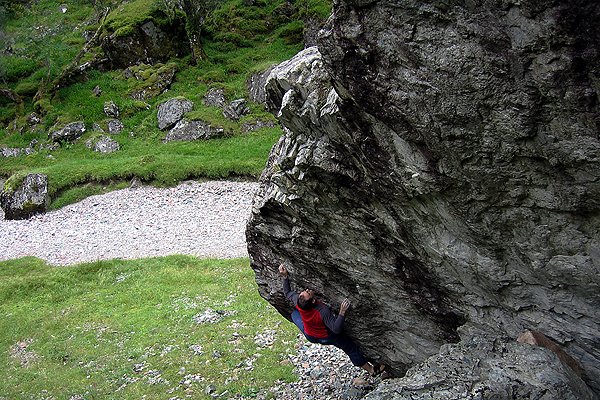
"...there is no such thing as 'hard' climbing or 'easy' climbing - more of this needs to be understood. 99 percent of us end up being just climbers, not 'Rock Gods', but really we haven't stopped doing the same things. When we give up the idea of competition and start motivating ourselves with our own goals rather than others' expectations, it becomes apparent nobody was watching all that time... your belayer is most likely thinking about dinner, a warmer duvet jacket or the next lead... whether you've just cranked out an E8 headpoint or topped out on a gripping V Diff, as long as the motivation has been rekindled, that's all that matters. Climbing on your own, solo, or just bouldering alone is a great way to source the real elemental stuff - it reminds you of your own limits, the boundaries you've set up. It is just movement on rock, moving through our own internal maps and renegotiating these boundaries - the only one you can't bribe is yourself! Also, too much concentration on training can be a bad thing, make the effort to get out on the real stuff despite the weather. Again, go exploring.

Climbing is a holistic experience: friends, geology, the route, weather, situation, history... you can rely on other elements while your motivation wavers: help a friend on a route, go out with someone new to climbing, go exploring, learn about geology, read some history, absorb other elements and don't expect to be the best climber on the planet... there is no such person."


For others on the same topic:

http://wiki.scottishclimbs.com/wiki/A_General_Guide_to_Training_for_Climbing

Popular posts from this blog

Beinn Dòrain

           Viaduct and Beinn Dorain Once you cross the bealach under Beinn Odhar north of Tyndrum, the shapely peak of Beinn Dòrain is a visual fanfare to the Highlands. The mountain and its environs are richly detailed in the poet Duncan Ban MacIntyre’s poem Moladh Beinn Dòbhrain (‘In Praise of Beinn Dòrain’). [i] Its symmetrical convexity, deeply gullied flanks like pencil sketch-marks, and stern domed summit, make this a moment to instinctively reach for the camera. It is a steep but invigorating mountain to walk, which is more leisurely explored from its eastern corries, though the traditional ascent from Bridge of Orchy, up to the toothed ‘Am Fiachlach’ ridge quickly brings fine views from the heart of the Central Highlands, encompassing Cruachan in the west to Lawers in the east and the Mamores to the north. If you were set the task to name the features and character of this mountain, before a Gaelic toponymy, you may have come up with a similar voc...

The Metadata of Being Human

Shamanistic zoomorphs, lithic graffiti, hallucinogenic tableaux, territory markings, knife-sharpeners … rock art – l'art rupestre – is so far beyond our traditional 'linguistic' history, it does not have an interpretative alphabet or a single line of confirmed meaning. There are many interpretations of the 'gravures' (carvings) and 'abris ornés' (decorated caves) in the hidden bivouacs throughout the forest of Fontainebleau. The sandstone marks easily under the nib of a hard flint from the deeper calcareous geology and this soft stone canvas has allowed our European ancestors to carve the stylised and modernistic strokes we might note as remarkable in a Picasso painting. Most of the carvings involve complex hash-marks and grids, overlaying each other, occasionally with mandala-like boxes. Sometimes there have been carved astonishingly beautiful anthropomorphs, (stylised human-like figures), or zoomorphs, (deities or humans manifesting in animal form) or argu...

Scotland's Iconic Mountains #Broad Law

BROAD LAW The rolling hills east of the modern motorway of the M74 hold much more character and history than they appear from the west, where they are now flanked by forestries of spruce and wind-farms. In medieval times this was a Scottish royal hunting ground – the ‘Ettrick Forest’.  Further east towards the Tweed valley, there are echoes of a deeper Scottish history in the border towns of Hawick, Selkirk, Galashiels, Peebles and Kelso, all on the banks of the historic River Tweed and famous for their medieval forts and abbeys.  Looking west from Broad Law to the monoculture forestry and wind-farms of 21st C Scotland This range of hills, along with the northern flanks of the Cheviot hills, marks the geographical transition to the once-contested border with Northumberland, with its high pass over Carter Bar on the A68. The more useful sense of boundaries are suggested not by the roads but by the watersheds: to the north the waters drain into the River Cly...