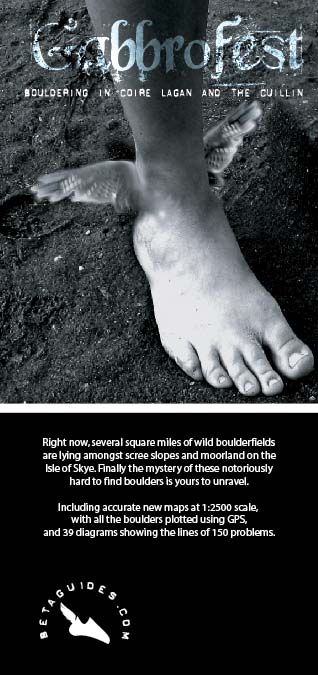
'Gabbrofest' out now!!


Right now, several square miles of wild boulderfields are lying amongst scree slopes and moorland on the Isle of Skye...

Not a bad intro! This is a labour of love and serious attention to detail, a quality addition to the bouldering topography of Scotland. James Sutton and Lee Robinson have produced an excellent map-guide to the bouldering on Skye, bringing clarity to the jumble of boulders in the great gabbro corries. The first thing that struck me was the simplicity of the layout, an A3 fold-out that packs neatly into a waterproof sleeve. Bird's-eye-view maps at 1:2500 scale locate you easily, numbered boulders refer to hand-drawn boulders, clearly marked lines and full descriptions, with V and Font grades... 39 diagrams, 150 problems... packs a punch all right.

If that's not enough, there are GPS locators for the boulders. The main areas described include:
Culnamean, Ghrunnda Boulders, Coire Lagan and An Sguman. Other areas mentioned are: Carn Liath, Skinidin, Elgol and An Caol on Raasay, though the concentration is rightly on the rough gabbro of the Coires. There are some excellent pics of classic problems such as Duck Boulder Arete, Snake Attack, Pump Up the Jam, Criss Cross and a classic shot of Ben Wear wiping off The Chieftain face out!!

I noted the inclusion of Si O'Conor's 'hard' problems with interest, having had my own share of frustration in trying to give Si the benefit of the doubt when it comes to cutting-edge problems. There is no doubt these lines exist as 'lines' and have been located by James, though Si still has to take responsibility for his claims and provide some core evidence of actually linking and climbing them. They are insanely blank propositions even to an experienced eye and to date Si has smoke-screened everyone who has tried to climb with him or film him on these problems... the author's own photographs are not enough to suggest full ascents. I guess James and Lee have shown a similar philosophy of generosity (describing Extradition, It's Over and Paper Tiger etc). Future guides and literature will not be so generous, I fear.

To get back to the guide, however, it is a thing of dedication and communicates the esoteric enthusiasm for gabbro bouldering... this is one of the wildest and most beautiful bouldering venues on the planet. You don't need a rope and rack to come home beaten up and exhausted by endless movement. There are hundreds of new problems to go at out there, but the circuit of problems described will cut your bouldering teeth (as well as your skin!). All-year round bouldering is possible due to the friction, though you won't want to be caught out on a still evening with the flying sharks... a dry winter day or a breezy summer afternoon are perfect here. The scenery gets you every time...

The guide should appear on the shelves of the outdoor shops soon, but to get a copy contact James directly at james@betaguides.com or check out www.betaguides.com

Well done boys... good production and an inspiring inventory of passion!

Popular posts from this blog

Beinn Dòrain

           Viaduct and Beinn Dorain Once you cross the bealach under Beinn Odhar north of Tyndrum, the shapely peak of Beinn Dòrain is a visual fanfare to the Highlands. The mountain and its environs are richly detailed in the poet Duncan Ban MacIntyre’s poem Moladh Beinn Dòbhrain (‘In Praise of Beinn Dòrain’). [i] Its symmetrical convexity, deeply gullied flanks like pencil sketch-marks, and stern domed summit, make this a moment to instinctively reach for the camera. It is a steep but invigorating mountain to walk, which is more leisurely explored from its eastern corries, though the traditional ascent from Bridge of Orchy, up to the toothed ‘Am Fiachlach’ ridge quickly brings fine views from the heart of the Central Highlands, encompassing Cruachan in the west to Lawers in the east and the Mamores to the north. If you were set the task to name the features and character of this mountain, before a Gaelic toponymy, you may have come up with a similar voc...

The Metadata of Being Human

Shamanistic zoomorphs, lithic graffiti, hallucinogenic tableaux, territory markings, knife-sharpeners … rock art – l'art rupestre – is so far beyond our traditional 'linguistic' history, it does not have an interpretative alphabet or a single line of confirmed meaning. There are many interpretations of the 'gravures' (carvings) and 'abris ornés' (decorated caves) in the hidden bivouacs throughout the forest of Fontainebleau. The sandstone marks easily under the nib of a hard flint from the deeper calcareous geology and this soft stone canvas has allowed our European ancestors to carve the stylised and modernistic strokes we might note as remarkable in a Picasso painting. Most of the carvings involve complex hash-marks and grids, overlaying each other, occasionally with mandala-like boxes. Sometimes there have been carved astonishingly beautiful anthropomorphs, (stylised human-like figures), or zoomorphs, (deities or humans manifesting in animal form) or argu...

Scotland's Iconic Mountains #Broad Law

BROAD LAW The rolling hills east of the modern motorway of the M74 hold much more character and history than they appear from the west, where they are now flanked by forestries of spruce and wind-farms. In medieval times this was a Scottish royal hunting ground – the ‘Ettrick Forest’.  Further east towards the Tweed valley, there are echoes of a deeper Scottish history in the border towns of Hawick, Selkirk, Galashiels, Peebles and Kelso, all on the banks of the historic River Tweed and famous for their medieval forts and abbeys.  Looking west from Broad Law to the monoculture forestry and wind-farms of 21st C Scotland This range of hills, along with the northern flanks of the Cheviot hills, marks the geographical transition to the once-contested border with Northumberland, with its high pass over Carter Bar on the A68. The more useful sense of boundaries are suggested not by the roads but by the watersheds: to the north the waters drain into the River Cly...